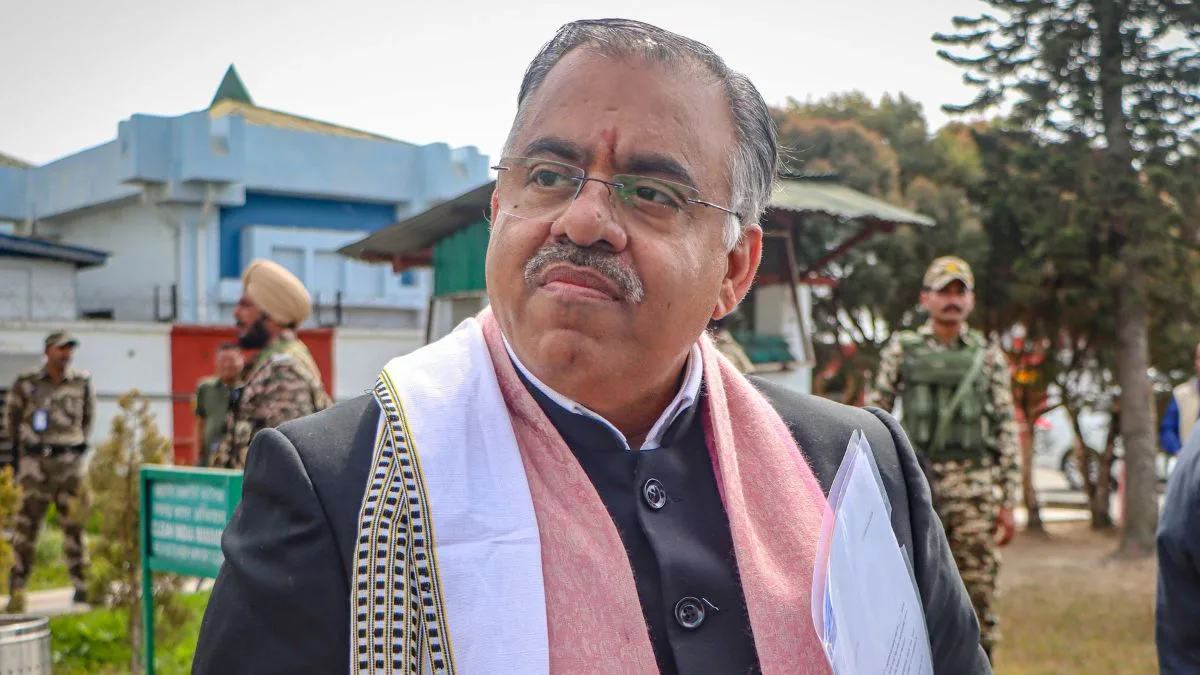
No link between DGEME Lt Gen Sahni and Thailand assault video, says Army
The clarification came after several posts circulated online, falsely linking a viral video from Thailand to the senior Indian Army officer.
“The Indian Army has already begun integrating AI into its core functions, and its effectiveness was demonstrated during Operation Sindoor,” he said.





Representational Image (IANS)
Dubbing Artificial Intelligence as a “Force Multiplier, former Director General Info Systems (DGIS) Lt Gen Rajiv Kumar Sahni has said that AI is reshaping the nature of warfare by bringing greater speed, precision, and adaptability to combat operations.
“The Indian Army has already begun integrating AI into its core functions, and its effectiveness was demonstrated during Operation Sindoor,” he said.
Advertisement
Speaking to the media after assuming his new role of Directorate General of Electronics & Mechanical Engineers (DG EME), Sahni said that across the world, armed forces are transforming rapidly through automation, digitisation, and the adoption of new technologies such as Artificial Intelligence (AI) and Big Data Analytics (BDA). These technologies help enhance operational effectiveness, improve situational awareness, and maintain a technological edge in combat, intelligence, logistics, and training.
Advertisement
The former DGIS also detailed the key AI-driven applications that were part of the operation. It included Electronic Intelligence Collation & Analysis System (ECAS), A home-grown software upgraded in real time to identify and prioritise critical threats, helping achieve strategic dominance.
Trinetra System, integrated with Project Sanjay, provided a common operational picture for better coordination, situational awareness, and decision superiority, and Predictive Modelling and Weather Forecasting Tools which enabled precise planning and targeting by predicting threats and weather conditions for long-range vectors.
“These innovations significantly enhanced the Army’s operational preparedness and response,” he said.
He further revealed that the Indian Army has mapped out six Lines of Effort (LoE) to drive structured adoption of artificial intelligence (AI) across its operations, aiming to enhance national defence capabilities while fostering innovation and self-reliance. LoE-I includes Alignment with National Missions, under which AI initiatives will be closely integrated with flagship programmes such as IndiaAI Mission, Digital India, Make in India, and Atmanirbhar Bharat to build sovereign defence technologies and reduce reliance on foreign systems.
Under LoE-II, Synergised Structures and Infrastructure wherein the Army plans to establish dedicated AI cells and strengthen collaboration among the armed forces, R&D institutions, academia, and industry, alongside creating secure cloud-based and edge-computing environments for battlefield applications.
LoE-III will look into Application Focus and Data Preparedness including high-impact use cases in surveillance, logistics, training, cyber defence, and battlefield management will be prioritised. The initiative also involves developing large, secure defence datasets and safe data-sharing mechanisms.
LoE-IV will have smart weapons and legacy systems whereing efforts will focus on developing AI-enabled autonomous platforms, including drones and unmanned vehicles, while modernising existing systems with predictive maintenance and decision-support modules.
LoE-V will look after Human Resource Development in which Defence personnel will be upskilled in AI, data science, and emerging technologies through partnerships with premier institutions and industry experts.
LoE-VI is focused AI Governance where a Defence AI Governance Council will be set up to ensure that AI deployment aligns with ethical, legal, and operational standards and international norms.
“These six focus areas mark a significant step towards the Army’s vision of leveraging AI to enhance operational efficiency, technological self-reliance, and battlefield readiness,” he added further.
“Additionally, the Army is developing an indigenous Unified AI Platform that will integrate operational, intelligence, logistics, and training applications on a single secure framework. This will replace fragmented systems and enable validated AI deployment within 24 hours, significantly enhancing operational readiness,” said the former DGIS.
Advertisement